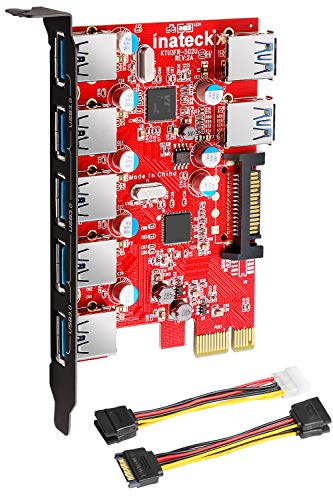
Inateck Superspeed 7 Ports PCI-E to USB 3.0 Expansion Card - 5 USB 3.0 Ports and 2 Rear USB 3.0 Ports Express Card Desktop with 15 Pin SATA Power Connector, Including Two Power Cables (KT5002)
- SuperSpeed USB 3.0 supports transfer rates of up to 5Gbps - The actual transmission speed is limited by the setting of the device connected.
- 7 Ports USB 3.0 downstream ports for standard desktop PCs; Support Hot Plug, Plug & Play; Support LPM, Low Energy Consumption.
- Operating System Compatibility: Windows XP, Vista, Windows 7,Windows 8 and Window 10(32/64-bit),Mac OS 10. 8 or above; Backwards Compatible with USB 2.0 and 1.1 devices.
- With quick installation, this USB 3.0 PCI express Card offers a simple solution for your standard desktop PC. Enjoy copying videos, music, photos, data files at blazing fast speeds.
- Notice: 1. It is necessary to connect the card to power supply of the PC. 2. For Windows XP/Vista Users, due to OS limitations, the real speed will be located between the level of USB 2.0 and 3.0


David Silver
WIN10 Users READ THIS
This card works with WIN 10. I had originally rated this product as 1-star because it initially did not work with my WIN10 machine. However after receiving phenomenal support form the vendor, I got it to work. The box comes with a CD which directs you to the Inateck website. Once there you have to search for your product to download the driver. At the time of this posting, 2 drivers were listed, but neither specified the applicable OS thus I did not use either driver. Rationale for my decision was that it was stated that if you had WIN10, you did not need to install any driver -- this is not true! (read below). If not loading the driver, the Device Manager only showed a generic USB 3.0 HUB. Here was THE FIX recommended by the vendor: 1. Connect the card to the power supply using the included cables (and applicable connectors inside your PC). NOTE: My previous card (although it had a power port) did not require the power supply connection. This card however does require use of the power supply port. Once connected, a green LED illuminates on the card. 2. Download/install driver ver-3.8.33709.0" from Inateck official website. NOTE: After installing the driver, my Device Manager indicated a specific (vs generic) 3.0 USB Hub. YES, I RECOMMEND THIS CARD. Good luck with your application.
Mariyam Faisal
since the Oculus compatibility tool doesn't like my motherboard's USB 3
I got this card for VR, since the Oculus compatibility tool doesn't like my motherboard's USB 3.0 ports. The card works perfectly well, and passes the Oculus compatibility test. Do NOT toss the CD away though. Windows 10 installed drivers for it on its own, but they didn't work for me. I had a bizarre problem with an external hard drive, which had horrible transfer rates when copying files TO it (~5 MB/s), but perfectly good ones when copying FROM it (90+ MB/s). The problem went away after installing the "Red card" drivers on the CD. In order to use the two internal USB ports on the card as front USB ports, I bought this:
Cynthia Martinez
Added a few more years to an aging PC
This is a great upgrade for my old X58 based workstation. I hate to buy a new pc just for some updated interfaces. This old thing is still a 6 core Xeon that performs very well. Comes with the power cables which is useful. The connectors in my case wouldn't reach so the SATA power slitter was a handy extension. Having to connect the power is a huge bonus for attaching devices. I have a USB 2.0 Blu-Ray drive that wouldn't behave right if it wasn't on the right port on the motherboard and even then it was flaky as it drew too much power. On this card, it operates reliably and having a 2.0 device on with 2.0 didn't slow anything down that I saw. All at the same time I was able to do 2 4tb Seagate External Drives copying at 130MB/s 1 240GB V300 SSD writing at 188MB/S in an Inateck enclosure Total throughput of 448MB/s USB 3 theoretically tops out at 640MB/s when you consider overhead and PCI-E x1 2.0 limit of 500MB/s I'm very happy. Couple notes for performance. Make sure it is installed in at least a PCI-E 2.0 slot if you have one on a 1.0 slot you will be limited to 250MB/s Download the drivers from the internet or use the CD. This thing was not performing up to speed and after installing the drivers there was a huge boost.
Amy Thurman
Works great and works in Multi-Card setup. Beware of newer drivers though (update)
I managed to get two of these cards installed on my ASUS Z-97 Pro motherboard. Both work well and now I have 10 external USB 3.0 ports and 4 internal USB 3.0 ports. I use the internal ports for things such as USB Bluetooth dongle, Logitech USB receiver (mouse, keyboard), a small hard drive mounted inside my PC case. The external ports work flawlessly and I've had no problems with them. If you have a motherboard similar to the ASUS Z-97 Pro and have a SATA drive plugged into the internal SATA Express port, then note that one of your PCIe slots will not function and you will not be able to use that PCIe slot as the SATA Express drive is taking up the data lane for that PCIe slot. This can be very frustrating if you aren't aware of this situation . To install one card it is straight forward and pretty much self explanatory. To install multiple cards you will need an open PCIe (and functioning) slot for each additional card and a power supply. I suggest a multi-SATA power cable. Before installing the second card, if you haven't already installed the first card do so and install the drivers and make sure it is working, then turn off the computer and slot in the second card and turn on the computer. You do not need to install the drivers again. The original drivers for the first card should recognize and configure the second card as well. You might receive a minor error while the computer is configuring the drivers for the second card. It shouldn't affect the functioning of the card. During the installation of the second card, once I turned on my computer, my computer automatically recognized the card and installed drivers for it automatically (which were the same drivers already installed and hence the error). Once you have the second card working, verify both cards are functioning properly. I don't think the drivers were really designed for multiple cards in mind, but they seem to work under Windows 7 64-bit no problem. As for Windows 10 I don't know. I deducted a star from my review because the drivers haven't been updated since 2014 and are likely out of date, especially for Windows 10. So, that is my experience with multi-card installation and my two cards are identical cards with identical chipsets. Using different cards with differing chipsets might yield differing results. I hope this helps anyone trying to get two or more cards working. ---------------update--------------------------- As of yesterday (1/27/17) after updating the drivers ( to 3.6.9.0 8/2/16), the external ports (all 5 ports on both cards) no longer work. The internal ports (2 on each card) still work fine, but no external ports work at all. Trying to diagnose the issue. I will update when and if I find a fix. --------------update ----------------------------- After some tinkering with the cards (installing and uninstalling and restarting the computer a few dozen times) I was able to determine the cause of the problem. It appears that when I updated the drivers to version 3.6.9.0 8/2/16 that the old drivers were left behind and still active. I imagine some sort of conflict was being caused with the old drivers and new drivers trying to control the same cards at the same time. Anyhow, the solution I found was to user Driver Boost 4 to uninstall all the drivers (old and new) (while removing the drivers you will find about 7 per card and they all contain the name 'Frisco' in their description). Once all the drivers were removed I removed both cards from my PCI slots and started my computer absent of the cards. Then registry cleaned my registry to get rid of any lingering registry entries. I then shut down the computer, and installed only one card then turned on the computer. Once the desktop appeared the card was present but no drivers could be found for it. That was a positive sign. So I installed the newest drivers again (3.6.9.0). I removed all the USB cables from the external ports and reconnected them one by one and they came back to life and all my devices worked. For the second card, I then shut down the computer and installed the second card (connecting power and placing in a seperate PCI slot). Then I restarted the computer. Once the desktop came up the computer automatically installed the drivers for the second card as it recognized that it uses the identical drivers to the first card. I connected my USB cables to the second card and everything worked as expected. So, the cards are very good, however, for some reason the new drivers did not uninstall the old drivers properly and that is what caused my problems.
Emmie Lou
Real deal that can be trusted.
As a content creator, I need a large number of USB ports. I'm always careful when it comes to putting things into my computer. These USB hubs are a bit tricky, there is a wide variety across price and features and no real 'brand leader', making finding a good one a crapshoot. I'm running a B360 Xtreme Motherboard with a GTX1060 Graphics card. There is plenty of space between the USB card and my GPU fans. The only downside is the power cable sags a bit and was hitting my bottom fans so I zip-tied it to another header cable to keep it up off the bottom. Not an issue if you do not have bottom-mounted fans, which is 90% of PC cases out there. This card was plug-n-play with Windows 10 ( ver.1903) FOR GEEKS: USB hubs share their bandwidth. This is true of stacked hubs on the motherboard as well as this card. The USB to PCIE controller on this board (FL1100) is a 4-port 5Gps transceiver. I *believe* that the top VLI chip (also a 4-port controller) is for the top 4-ports and the bottom three (3) ports are direct to the FL1100. So I'm *assuming* that the bottom three support 1.25Gbs, and the top four support 300MBps.
Love Die
Important Issue To Know About Installation
Here's an important piece of info. When installing this under Windows 10, the instructions say it will automatically download and install the driver. It fools you, the card works perfectly, however in Device Manager it shows up as unknown device and downloading drivers from their Support site does not visually fix it, although the most current drivers are on their website and will install in Windows 10 when you download and install them manually. It is important to make sure you have the most current Windows 10 updates installed so you have the Windows drivers available also. What I discovered is... when you plug a device into the card, it sees your device and the unknown device disappears in Device Manager. If you disconnect all of the USB external devices, it becomes an unknown device again. It seems to be a quirk, however the card is easy to install, works perfectly and is fast. I had sent one back thinking it was defective, however I spent more time trying to troubleshoot this one and that's how it functions. Hope this helps.
Mary Wanjiku
This works great
Some other reviews almost made me not buy this. I'm glad I did, it works great. Just remember, for this card you have to: 1. open the computer case and install the card in an empty PCIe slot 2. connect power from your PSU to the card (comes with adapters, you still need an empty spot on a power cable to connect it to) 3. install drivers from the included CD or from online If you can't or don't want to do any of the above 3 steps, try a different card. If you do all three steps above, it works fine. My build is a brand new Win10 pro set up.
Pierre Francois Du Plessis
Works Great with Windows 10 on older PC!
I've been using this card for two months now 24/7. Installation was very easy on my Windows 10 PC running on an older i7-860 CPU and an Asus P5P55C motherboard that did not have USB 3.x ports. I already had one 3 port USB 3.0 PCIe card in it, but needed more USB 3.0 ports. I bought the version with a rear 20-pin USB 3.0 header connector, as oppposed to the version with the two rear USB 3.0 ports. This version of this card does not seem to currently be an option. In order to have two of the ports available from the front of my Pc I also purchased an Anker 2-Port USB 3.0 3.5 inch Front Panel Data Hub that fits into a hard drive bay and provides USB 3.x ports. https://smile.amazon.com/dp/B00J4EZE4U/ref=cm_cr_ryp_prd_ttl_sol_5 If installing into a 5.25" hard drive bay like I did you will need a 5.25" USB 3.x panel like this one. https://smile.amazon.com/gp/product/B01FWK8PMC/ Those USB 3.x front panels require a USB 3.x header connector to plug into, typically found on motherboards, but in my case I connected the header cable to this Inateck USB 3.0 7-port card's 20-pin rear header connector. I did not have to install any driver software. I contacted Inateck asking if I should install their driver and they said that if the card was functioning to NOT install their driver. I am using ALL 7 ports and have not had any trouble. The speed is very, very good. This card works! I would definitely buy again. Note: I always recommend installing the rear power connector BEFORE you install any PCIe card in the motherboard slot. This allows you to get a better hold of the card's power connector and not risk breaking the connector off. It can take considerable force to install a power connector, so this reduces any risk. I did not have any trouble and the power connector fit was actually very good.
Christy Marshall
Great purchase to improve Oculus Rift tracking
I got this because my motherboard did not offer enough USB 3 channels to give the Rift Headset its own dedicated channel. As a result some VR games had trouble tracking when demand got high, such as Beat Saber and I'd get lots of lag, missed swings, etc. This card goes right above the video card on my board and came with adapters to go from old ATX style power connections to the new SATA style that the card uses. I did not need to use the adapters since my Power Supply had ample SATA style power connections to use. I use Windows 10 and the included CD for the drivers to this card was never needed. Windows picked the card up instantly on first boot and the Rift was ready to go in minutes. Beat Saber works flawlessly now and all I have going to this card is the Rift USB 3 connection for the headset. Great purchase! I couldn't be happier. I purchased the card with the two internal USB ports, where I'll be placing a USB Wifi and USB bluetooth adapter later on. This card has 3 dedicated chanells to use, which means this should have no effect on the Rift tracking. The channels are clearly marked on the card itself for easy identification. No need to go digging through device manager.
Oshi Amarasinghe
Got an Oculus Rift? Just go ahead and buy this.
Perfect for Oculus Rift sensors, and a necessity for room scale VR. My PC has an X99 mobo, and came with like 10 USB 3.0 ports, and 2 USB 3.1 ports, so I figured I wouldn't need this. Only 2 of my built-in ports worked great for the rift sensors, and those were the ones run by an Intel controller. I went with this model because of the 2 standard 3.0 ports (instead of headers for external connections like on my mobo). You never know when you might want to plug something up inside your case that uses a standard USB port. LED strip, etc. The 2 things that helped me the most to getting my room scale setup working properly. (1) Finally giving in and installing Windows 10 (most of my sensor issues went away just from this) (2) Installing this card. It ensured the rest of my problems went away.